5E Intel
FAQ

Frequently asked questions.

Everything you might want to know about 5E Intel — the platform, the pricing, and the 5E Behavioral Profile.

i. Getting started

What 5E Intel is & how it works.

What is 5E Intel?

5E Intel is an AI-moderated interview platform. Researchers, recruiters, product teams, journalists, health teams, and civic groups use it to run voice, video, or chat interviews at scale — concept tests, brand trackers, candidate screens, usability sessions, detractor follow-ups, source interviews, and anything else where a real conversation matters.

The AI moderates, listens, probes, and adapts. You bring the question; it brings the conversation.

What you get back:
  • Transcripts, recordings, and AI-marked highlights for every interview
  • Cross-interview synthesis and a written summary
  • Respondents join in under a minute, on any device, with no scheduling
  • Free for participants — teams pay per completed interview, starting at $2
Does the AI moderator replace human conversation?

No — and that’s by design. 5E Intel exists for the conversations you’d run if you had infinite time and the right moderator on staff. It doesn’t replace the strategic call, the in-person interview, or the synthesis you bring as the person who actually cares about the answer.

What it does: handles the volume. Instead of 5 phone calls you can run 100 conversations and still hear every voice. Then you spend your face-time with the people, the moments, or the patterns that earned it.

The result: More people get the space to talk. Your follow-ups land on what actually matters — not what made it through a keyword filter.
How does an AI-moderated interview work?

From the respondent’s side, it works like a conversation with an intelligent moderator:
  1. Receive a link from a study owner, or open one in the app
  2. Choose a response mode — voice, video, or chat
  3. Answer naturally — the AI listens and responds in turn
  4. Get intelligent follow-ups — the AI probes deeper based on what you said
  5. Finish — usually 10–30 minutes, depending on the study
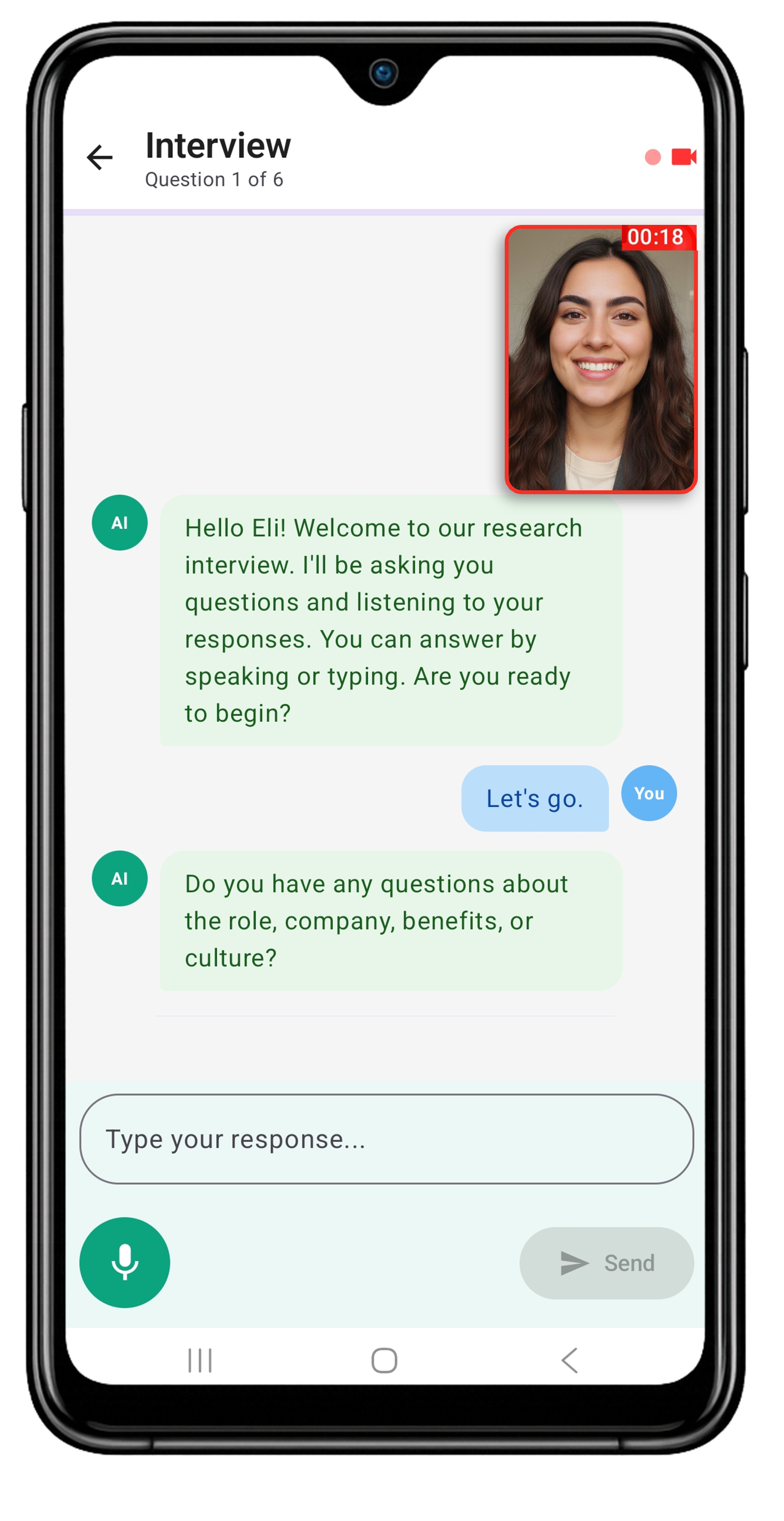
5E Intel Interview Interface
The interview interface shows your progress and current question
ii. Pricing & credits

What it costs.

Is 5E Intel free for participants?

Yes — taking an interview is completely free.

You can create an account, complete your profile, and take any AI interview at no cost. The team running the study pays per completed interview. Optional premium features — like unlocking your full 5E Behavioral Report — are available for purchase if you want them, but nothing is gated behind a paywall to participate.

Respondents never pay to talk. The people running the study cover the cost.
What is a credit and who pays for credits?

A credit is the unit of currency on 5E Intel:

  • The team running the study (researchers, recruiters, product teams, etc.) purchases credits
  • Participants never pay to take an interview
  • When a respondent completes an interview, credits are deducted from the team’s balance
  • Participants can optionally purchase credits to unlock premium features like a full 5E Behavioral Report

View full pricing details

5E Intel Credits Dashboard
Teams manage their credit balance in the billing dashboard
How much does 5E Intel cost to run a study?

5E Intel uses a credit-based pricing model with automatic volume discounts. Standard interviews start at $2 each; conversational and phone interviews are more compute-intensive and cost more.

By interview type (at Tier 1 — $2/credit):

Interview TypeUnder 60 minOver 60 min
Standard — chat or video survey1 credit · $22 credits · $4
Conversational — real-time AI voice2 credits · $44 credits · $8
Phone — AI calls the participant’s phone3 credits · $66 credits · $12

Volume discounts apply automatically — price-per-credit drops as you buy more (Tier 1: $2 → Tier 2: $1.90 → Tier 3: $1.80).

Reports vary by depth — a single-interview Summary is 1 credit ($2 at Tier 1), and the full 5E Behavioral Report is 5 credits ($10 at Tier 1).

View full pricing details

Contact us at contact@5eintel.com for custom enterprise pricing.

iii. Features & capabilities

What the platform can do.

What kinds of studies can I run?

If you can describe what you’d want to ask, the engine will sit down and ask. Common study types:

  • Concept & brand — concept tests, brand trackers, packaging studies, ad evaluation, segmentation
  • Hiring & talent — async screens, behavioral interviews, case walkthroughs, culture-fit conversations
  • Product & usability — prototype tests, onboarding interviews, jobs-to-be-done, feature feedback
  • Customer & retention — detractor follow-ups, churn diagnostics, win/loss, longitudinal check-ins
  • Anything else — alumni research, source interviews, patient outreach, civic listening, diligence calls, employee voice, beta testing, ethnography

Studies can be voice, video, or chat. Respondents join in under a minute on any device — no installs, no scheduling.
5E Intel Interview Modes
Choose between voice, video, or chat modes — respondents pick what fits
How does the AI generate follow-up questions?

The AI moderator reads each response in real time and decides what’s worth probing:

  • If a respondent mentions a specific moment or detail, it asks for more
  • If they reference a feeling or a strong opinion, it asks why
  • If an answer is brief or hedged, it gently asks them to elaborate
  • It keeps your study objectives in mind, so follow-ups stay on the thread you care about
The result is a conversational flow that surfaces the texture static questionnaires miss — the actual reason, not the polished response.
Is there a mobile app?

Yes. 5E Intel has an Android mobile app (iOS coming soon).

With the mobile app you can:
  • Take AI interviews on your phone
  • See interviews you’ve been invited to
  • Manage your profile and settings
  • Review your interview history
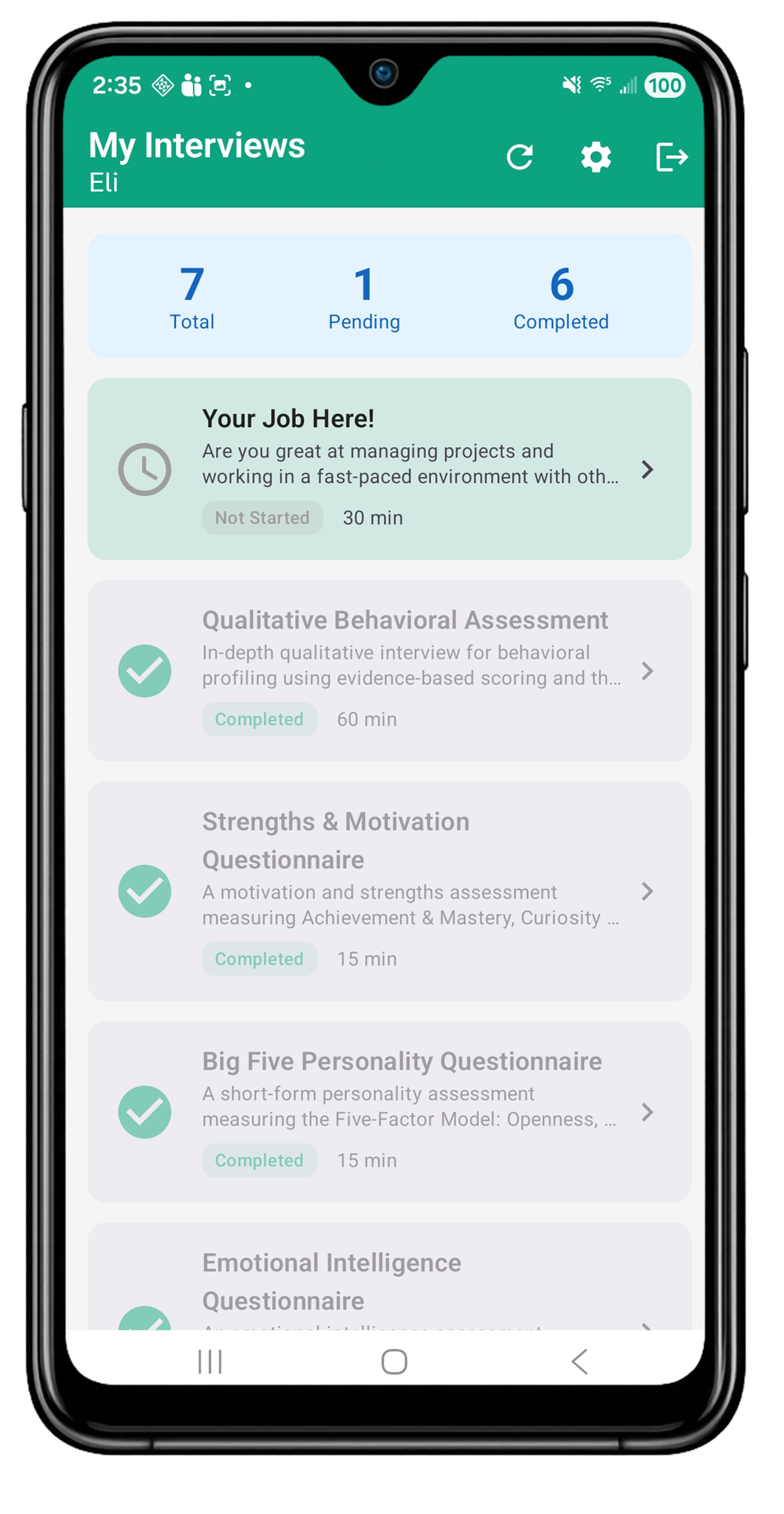
5E Intel Mobile App
Complete interviews anywhere with the mobile app
iv. For teams running studies

From volume to signal.

What do I actually get back after a study?

For every interview, you get the conversation and the synthesis:

  • Full transcript — searchable, with timestamps
  • Recording — voice or video, whichever the respondent chose
  • Highlights — AI-marked moments worth your attention
  • Written summary — what the conversation actually said
  • Cross-interview synthesis — themes, quotes, and patterns across the whole study

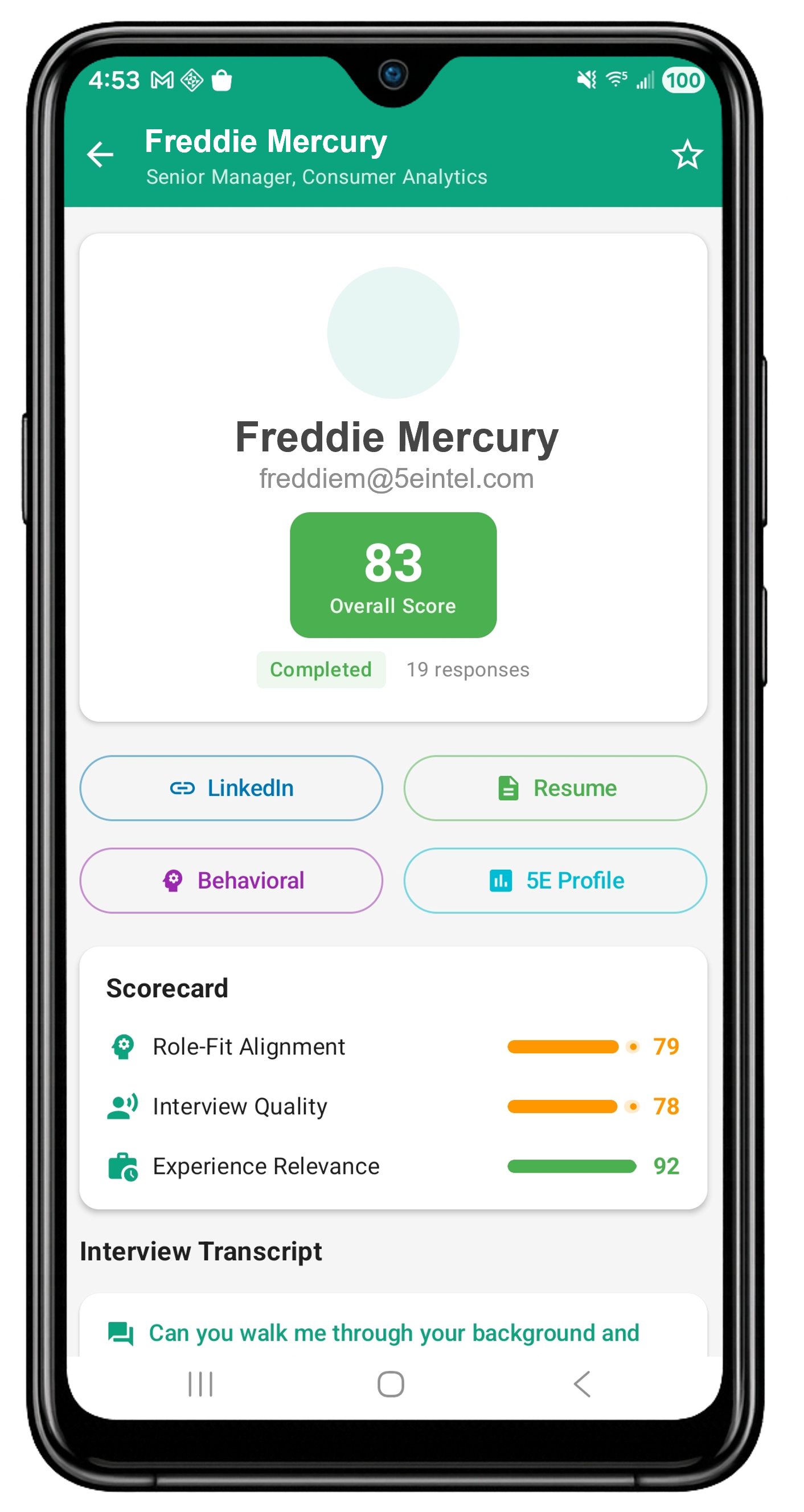
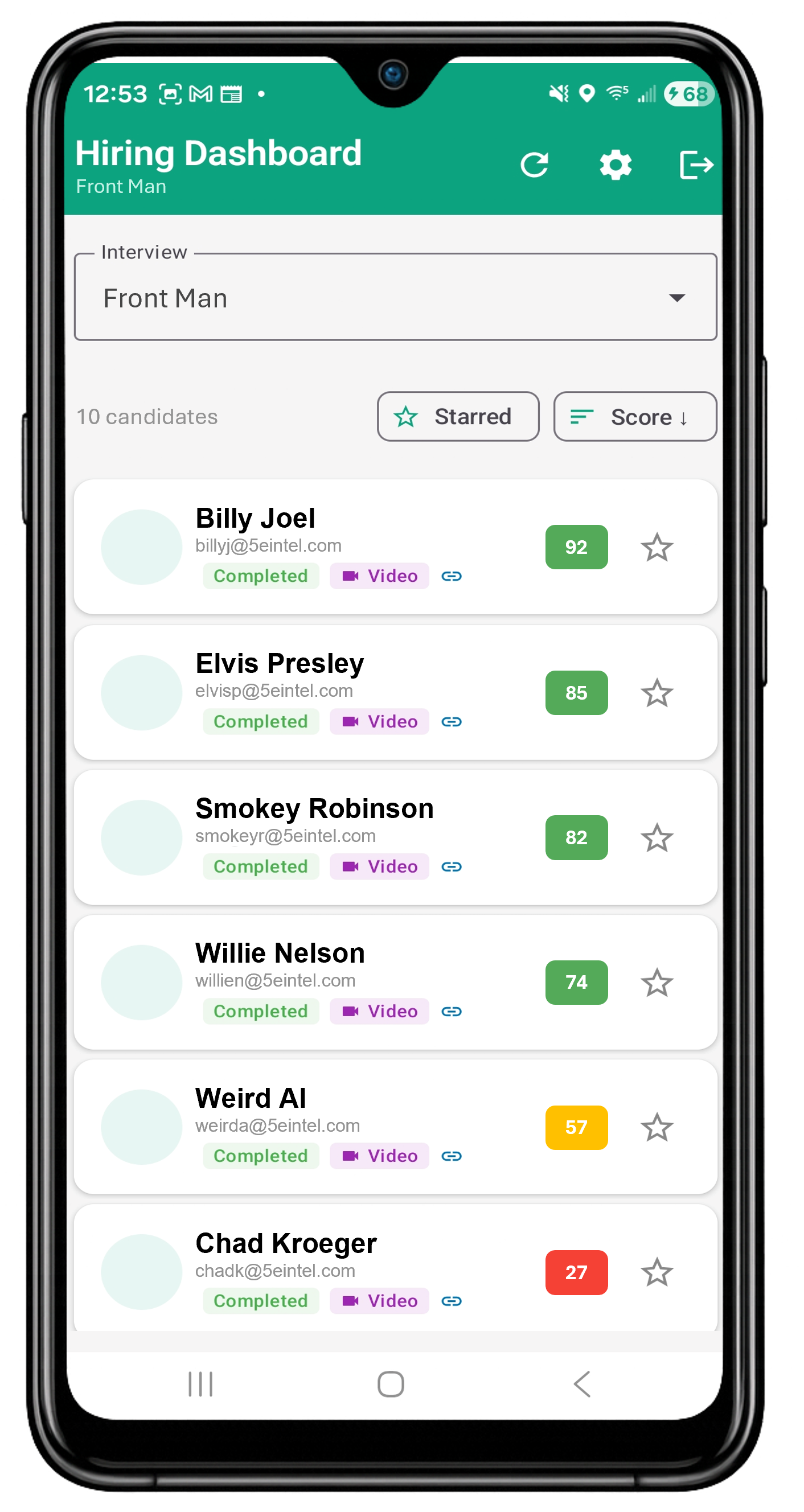
For hiring studies, scorecards add communication quality, response depth, and behavioral signals against the role profile. For research studies, you get theme clustering and quote extraction tied to your objectives.

The point: you stop watching every interview and start jumping to what matters.
What is the 5E Framework?

The 5E Framework is a behavioral profile across five dimensions:

  • Exploration — curiosity, learning appetite, openness to change
  • Empathy — emotional attunement, relationship orientation
  • Engagement — social energy, collaboration style, enthusiasm
  • Execution — discipline, reliability, follow-through
  • Ethos — purpose, integrity, values alignment

Each dimension is a spectrum, not a judgment. A “low” Engagement score doesn’t mean “bad” — it means independent work over constant collaboration. The right score depends on what you’re trying to learn or hire for.

Extended metrics also include: Stress Response Style, Tenure Propensity, Persuasion & Coalition Building, and Outcome Drive.
How does this help me decide who to follow up with?

The synthesis layer is built to surface follow-ups — whether that’s a second interview, a clip you want to share, or a customer you want to call back:

  1. Sort and filter by relevance, theme, sentiment, or any custom signal you defined for the study
  2. Compare profiles — see how respondents cluster on dimensions that matter
  3. Skim summaries — get the gist without watching every interview
  4. Jump to key moments — AI marks the most revealing parts of each conversation

Whether you’re picking three candidates to bring in or five customers to call back, the time you spend lands on people who’ve already shown you something.

Can I customize what gets scored or summarized?

Yes. When setting up a study, you choose which signals matter:

  • A concept test might focus on specificity of reaction and spontaneous mentions
  • A hiring screen might emphasize experience relevance and communication quality
  • A churn diagnostic might prioritize sentiment shifts and stated reasons
  • A usability session might track confusion moments and task completion language

You define what “useful” looks like for your study, and the AI evaluates accordingly.

v. Why an interview & not a survey?

What surveys miss.

Why use an AI interview instead of a survey or form?

Surveys collect answers. Interviews collect reasons. The same five-star rating can mean “I love it” or “I’m fine, I guess” — you find out which by talking. AI moderation lets you have that conversation at survey-scale:

  1. Real conversations vs static forms — the AI listens and asks intelligent follow-ups in the moment
  2. Voice, video, or chat — respondents pick the mode that fits, and you get the texture of how they say it
  3. Deeper signal — reasoning, emotion, and specificity that doesn’t fit on a Likert scale
  4. Consistent at scale — every respondent gets the same study objectives without interviewer fatigue or drift
  5. 24/7 availability — respondents participate anytime, anywhere, with no scheduling
  6. Built-in synthesis — transcripts, highlights, written summaries, and cross-interview themes — ready when you are
The bottom line: A survey gives you a number. An interview gives you the story behind it — in the respondent’s own words, with the moments worth your time already marked.
Why are research and recruiting teams adopting AI-moderated interviews?

The same constraint hits both kinds of work: you can’t talk to enough people. So you fall back on surveys, resumes, and ratings — and lose the texture in the process. AI moderation removes the constraint:

  1. Numbers miss the “why” — the texture of how someone explains their reasoning doesn’t fit in a survey scale or a CV
  2. Conversational responses are richer — you hear the example, not just the keyword
  3. Structured signals at scale — same questions, same criteria, every time — without the cost of a human moderator
  4. Predictive over time — for hiring teams, interview-derived signals correlate with job outcomes better than resume credentials
  5. Consistency without fatigue — review 100 conversations without the bias drift of doing it manually
  6. Lower barrier to participate — free for respondents, on any device, in any mode — broader and more representative reach
Research: Resumes predict only 5–15% of job performance variance. Structured interviews predict 25–30%. The same principle holds for research: unstructured surveys lose half the signal you came for.
How does 5E Intel compare to surveys, forms, and traditional research tools?
CapabilitySurveys & forms5E Intel
QuestioningStatic, pre-setDynamic, with real-time follow-ups
Data depthRatings & short textRecordings, transcripts, behavioral signals
SynthesisManual or basic chartsAI highlights, summaries, cross-study themes
Respondent experienceForm fatigueConversation on any device, in any mode
ConsistencyDepends on instrumentAlgorithmic — same objectives, every interview
ScalabilityLoses depth as N growsHolds depth at any N
How does AI reduce bias in interviews?

Whether you’re screening candidates, recruiting research respondents, or interviewing customers, bias creeps in whenever a human is tired or rushed. AI moderation helps surface the signal rather than the impression:

  • Consistent criteria — every respondent is evaluated against the same objectives, with no “gut feel” drift
  • Focus on what was said — the AI reads transcripts and reasoning, not pedigree, names, or backgrounds
  • Less reviewer fatigue — summaries and highlights protect human judgment for the moments that need it
  • Pattern detection — for hiring teams, you can identify which traits actually predict success and weight those, not lazy proxies
  • Lower barrier to participation — free for respondents, on any device, removes financial and access constraints that distort who shows up
Real impact: Hiring teams using AI interviews report more diverse candidate pools reaching final rounds. Research teams report hearing from respondents who’d never have completed the 40-question survey.
vi. Your profile

Setting up your account.

What information do I need to provide during onboarding?

During onboarding, you can optionally provide:
  1. Profile picture: helps the team running the study recognize you
  2. LinkedIn profile: connect your professional presence (useful for hiring screens)
  3. Resume/CV: upload once, attach to any interview
  4. Demographics: for studies that ask (always optional and confidential)
  5. Salary expectations: useful for job-related studies (optional)
All fields are optional — you can skip any step. The more you fill in, the smoother future interviews go, but nothing is required to participate.
5E Intel Profile Setup
A complete profile makes it easier for study owners to know who you are
vii. 5E behavioral profile

The behavioral profile.

What is the 5E Behavioral Profile?

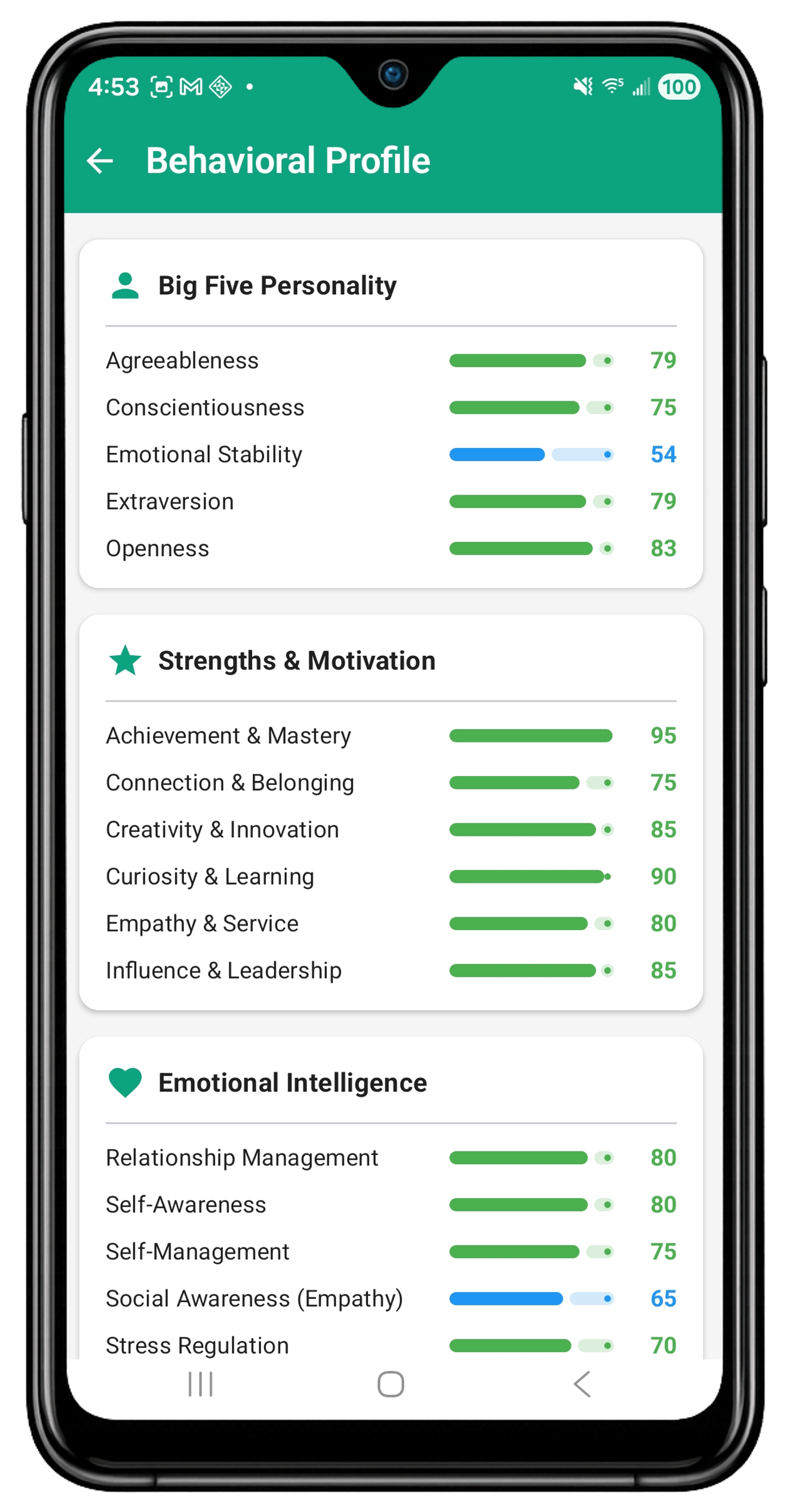
The 5E Behavioral Profile is a comprehensive personality assessment based on the scientifically-validated Big Five personality model (also known as OCEAN). It measures five core dimensions:

  • Openness — creativity, curiosity, openness to new experiences
  • Conscientiousness — organization, dependability, self-discipline
  • Extraversion — sociability, assertiveness, positive emotions
  • Agreeableness — cooperation, trust, helpfulness
  • Emotional stability — resilience, calmness, stress management
Why it matters: Understanding your behavioral profile helps you identify your strengths, areas for growth, and how you work best with others. It’s valuable for career development, team fit, and self-awareness.
Is the 5E Behavioral Profile free?

All 5 behavioral assessments are completely FREE for all users.

  • Taking the assessments: FREE — complete all 5 personality assessments at no cost
  • Viewing your scores: FREE — see your scores on each dimension as you complete them
  • Full 5E Report: 5 credits — unlock your comprehensive report with detailed insights after completing all assessments
Incredible value: Similar personality assessments like DISC, Myers-Briggs, or Hogan cost $150–$500+ per person. With 5E Intel, you take the assessments for free and unlock your full report for just 5 credits.
How does the 5E Behavioral Profile compare to other assessments?

The 5E Behavioral Profile is based on the Big Five personality model, the most scientifically validated personality framework used in organizational psychology.

AssessmentTypical CostScientific Validity
DISC Assessment$50–$200Moderate
Myers-Briggs (MBTI)$50–$150Low–Moderate
Hogan Assessment$150–$500High
CliftonStrengths$50–$100Moderate
5E Behavioral Profile$10High (Big Five based)

The Big Five model is preferred by researchers and I/O psychologists because it has decades of peer-reviewed research supporting its reliability and predictive validity for job performance.

What’s included in the full 5E Report?

After completing all 5 assessments, you can unlock your comprehensive 5E Report (5 credits), which includes:

  • Detailed trait scores — your percentile ranking on each of the 5 dimensions
  • Strengths analysis — what your profile says about your natural talents
  • Growth opportunities — areas where you might focus development
  • Work style insights — how you likely approach tasks, collaborate, and handle stress
  • Career fit indicators — types of roles and environments where you may thrive
  • Team dynamics — how you might interact with different personality types
Your report is private and belongs to you. You can share it with anyone you choose — potential employers, study owners, your own coach — or keep it for personal development.
How long do the behavioral assessments take?

Each of the 5 behavioral assessments takes approximately 5–10 minutes to complete.

  • Total time: about 25–50 minutes to complete all 5 assessments
  • Flexible: you don’t have to complete them all at once — save your progress and return anytime
  • No right or wrong answers: answer honestly for the most accurate profile

The assessments use a mix of rating scales and situational questions designed to capture your natural tendencies and preferences.

Can others see my 5E Behavioral Profile?

Only if you choose to share it. Your 5E Behavioral Profile is private by default.

  • When participating in an interview, you choose whether to attach your profile
  • Some study owners (employers, researchers, coaches) may ask for it as part of the conversation
  • Sharing it can help signal self-awareness and how you tend to work
  • You stay in control of who sees the results
viii. Privacy & security

How we handle your data.

Is my interview data secure and private?

Yes — we take data security seriously:

  • All recordings and transcripts are encrypted
  • Data is stored on protected servers
  • Your responses are only shared with the team that invited you to the interview
  • We comply with privacy regulations (see our Privacy Policy)
  • You can request deletion of your data at any time
What happens after I complete an interview?

After you finish:

  1. Your responses are transcribed (if voice or video)
  2. The team that invited you receives a summary and full transcript
  3. They can watch or listen to the recording
  4. They may also see AI-generated highlights from your conversation
  5. They’ll follow up directly if there are next steps
5E Intel Interview Complete
Track your completed interviews in your dashboard
Ready to start

Talk is cheap. So let them talk.

Free for participants. No platform fees, no subscriptions — pay per interview, starting at $2.

Create free account See pricing